Wednesday, February 28, 2007

New Blogger login help

Switched to New Blogger and can't log in? Well, exactly the situation that I found myself in for the past one week when some of the best stories inspired me in a long time!

Well, finally I am back. Here is how:

To log in, DON'T use www.blogger.com. Instead go to:

https://www2.blogger.com/login.g and log in with the Google ID that you used during the switch.


This tip came in when I finally turned to LinkedIn Answers for help. Amy Dullard, an advanced applications programmer at 1K Studios, gave this full tip:

Are you logging in here: https://www2.blogger.com/login.g with your Google ID? Or at the old blogger login? There is also info on having trouble with your Google login at: http://www.google.com/support/accounts/bin/answer.py?answer=40548


Meanwhile, New Blogger has made the template editing stuff much easier. I am playing around with the template change that can now be done visually - through a WYSIWYG editor.

Thursday, February 08, 2007

Zaadz.com: Conscious Capitalist Network


Zaadz.com is a social network, but it's not socialist. Instead, its "conscious capitalist."

According to Zaadz, this is what their business is:
"We're in the process of building THE most inspired community of people in the world…social networking with a purpose, a community of seekers and conscious entrepreneurs circulating wisdom and inspiration and wealth and all that good stuff. We're passionate about inspiring and empowering people to bring their dreams to life, learning and growing and getting paid to do what they love, using their greatest gifts in the greatest service to the world. (And having fun in the process!)"

Zaadz means "seeds" in Dutch. Created by self-described "friendly philosopher" Brian Johnson, a starry-eyed UCLA grad, Zaadz is to spread the seeds of love. If you want to understand what this means, you will first have to know about the growing global trend towards spiritualism and the need of a new point-of-view to replace the old.

Zaadz offers own blogs, photo collections, "pods" (communities), tagging of books, teachers, inspirational people, and all those
folksonomic features now a staple of Web 2.0 social networks.

Why is Zaadz.com a phenomenon to watch?
I discovered this community through a cyber-pal's recommendation and joined in curiosity. While I still figure out what this site means to me, I am glad (in some ways) that it confirms to my feeling that there is a general global unrest with prevailing social/ political/ capitalist/ old world/ new world order ideas; and that the young want change. Zaadz.com to me is the proof, if nothing else.

For now, Zaadz seems to have an idea that is born in the right time, but a need to be more "tangible." It is also billed as uber-positivist by some.

Whether Zaadz delivers on its ideas or not is another question best answered by time; what is truly significant about it is the fact that not only it exists, but it represents the ambitions of thousands of its often young members from over 110 countries. Young and connected, the members of Zaadz (called "Zaadzsters") and other similar network represent a very real way of thinking people are developing all over the world.

Taking notes, anyone?

Conscious Capitalism: Dirty Business No More

Muhammad Yunus, the Nobelist who created "micro finance," coined the term Conscious Capitalism. Patricia Aburdene saw it as a "moral transformation" and "today's greatest mega-trend" way back in fall 2005. Social networks such as Orkut have been abuzz with it. And now finally, Conscious Capitalism has arrived. It's here to stay. And it's changing the face of the way business is going to be done.

What is conscious capitalism?
According to BBC News E-cyclopedia , "Conscious capitalism stands for a more moral approach to what is often seen as the dirty business of business. Where once a company would bow only to the demands of its shareholders and customers, under the new order it must take on board its impact on everyone with a direct or indirect interest."

Ever heard the economic term "externalities?" This obscure term means costs that are traditionally external to business activity. Such as, pollution. Disturbance of personal lives of over-worked employees.

I've added the word "traditionally," otherwise, the traditional thinking never considered this cost the responsibility of business.

Conscious Capitalism factors these costs in. It makes businesses and executives responsible to more than financial stakeholders. The society itself is seen as a stakeholder. Which is why sometimes this term overlaps "socialism," which it is not.

As of Feb 2007, when this trend is going to press, a frantic search for a new business model that factors in the externalities is on. Micro-finance is one of the answers; but "conscious capitalism" intends to replace good old profitable business with a more responsible for-profit model.


Read More:
BBC News E-cyclopedia entry on Conscious Capitalism
Megatrends 2010: The Rise of Conscious Capitalism, by Patricia Aburdene. @ AMAZON

Saturday, January 27, 2007

Emerging Concept # 1: COMMUNITY

What will be the buzz word (or phrase) of 2007?
This question by Steven Burda on a social network prompted me to launch the Concepts series.

My answer: Community.
2.0, YouTube, Flickr, glocalization - whatever. It's "community." I also suggest "Local" as an off-shoot concept of the above.

COMMUNITY
There are two broad applications of this concept: one in the virtual world of Internet, and one in the real world.
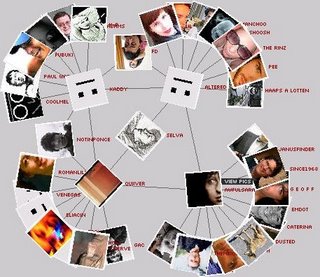
Communities 2.0 - the virtual world
The child of social networking sites meeting user-content driven (web 2.0) websites: communities.

Built around common interests, preferences, or themes, communities are virtual spaces that bring together like-minded folks. On social networking sites such as Orkut and user-content driven spaces like Flickr, users can quickly and easily create thematic communities that attract the interested.

Unlike the older days of the Web, these "2.0" (new Web) communities are self-regulating and flexible. Rules are minimal, and members are encouraged to familiarize themselves with them, and regulate their own behavior. Individuals moderate or own the communities; the success of their "leadership" depends directly upon their abilities and acceptance by the members. A badly regulated, dismal communities dies by attracting no members, who are free to "settle" into another space or create their own. Good leadership - determined by the leader's tolerance, inclusiveness, conflict resolution, and community marketing skills - leads to healthy, growing communities that attract both members and participation. Charisma works.

Communities are small localities and nations in their own right. This is why I suggest that the Internet is the blueprint for a truly human(e) government. (Internet - government of the people: Here and here.)

Because of their open nature and inclusiveness of opinion, communities offer real insights into social life. Thanks to technology, they are fast-paced, ever-evolving, and allow for quick spread of info. Communities also change their form quickly to suit a campaign or project.

This is why, truly savvy change leaders and marketers are taking note of the phenomenon. The Future of Communities is a blog branched out from the upcoming Community 2.0 Conference. It's all about communities and their growing power in the new world of Internet.

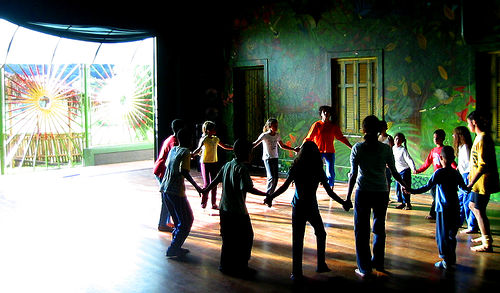
Community - local neighborhoods of the real life world
In RL, communities are making a big comeback.

Caring. Giving. Sharing. Giving back. Participating. Responsibility. Local - all these once discarded social concepts are back, and they are here to stay.

There is a growing concern about the rise of "ethnic clash" in the world. I see it the other way. I think that for the first time in human history, the not-so-privileged ethnicities are respecting themselves and understanding that they are as equal as any other human. They are not condemned.

On the other hand, the privileged world, having enough of all resources possible, is looking for "meaning". On the one hand, their excessive resources are going to war. On the other hand, there are people who have taken it upon themselves to give back to the world: within their own community, and then globally - depending upon each individual's circle of influence. This is leading to the growing trend for nomadic lifestyle, often mixed with philanthropy or volunteer work.

This is the larger picture. On smaller levels, the "have's" - especially the youth - are giving back to their communities. The more experienced are realizing that they have to invest in the youth and in building neighborhoods. Only in this lies the safety of people, and any hope for restoring peace and minimizing crime.

Respect for one's own culture, the realization that we have to work together in neighborhoods and that we can't demand rights without performing duties, the sense of delight in serving, freedom with responsibility and a new respect for family and society's institutions (more open, more flexible, more inclusive) - are the highlights of this emerging concept.


Photo credits:
Top: Flickr user Cobalt123, Bestgraph, 2005
Bottom: Flickr user carf (Gregory J. Smith), Friendships - 1, 2005
E-mail: nextbyramla AT gmail.com

Emerging Concepts + Advocated Concepts


NEXT> will feature two series of blog posts on "Emerging Concepts" and "Advocated Concepts."

"Emerging Concepts"
"Emerging Concepts" are sustainable trends being observed around the globe which have already gained some degree of acceptance by global change agents; and are "visible" should one go looking.

"Advocated Concepts"
"Advocated Concepts" are concepts and change ideas championed by NEXT>. They may or may not be accepted or observable as yet; but once in action, they achieve the dearest ambition of good souls: Making the World Better. The simple criterion for advocating them is the "humanity" of the concept.

I hope that "Advocated Concepts" will replace some of the age-old inhuman beliefs upon which much of the current education and thinking of the modern human is based. It's time to think anew and afresh.

New Thinking
This new thinking is not just based on aspiration, but it is also a "lesson learned" from the many forms of experiments that the human race has carried out in all fields - form society & governance to technology, education, health care, and living.

Through this series, I envision what the world can be if we successfully weed out inhuman concepts from our psyche, and replace them with new thinking. And I share this vision with the readers of the blog so that you may be motivated; and come together with like-minded souls through NEXT>.

Claimer
In analyzing, predicting, and curating these concepts, I am exercising the freedom to predict with responsibility. By a self-imposed ethical policy, NEXT> will only predict or report findings that can help the world be a better place - rather than increasing anxiety which most of predictions do.

NEXT> will be helpful to those who want to make things better, and need to see the opportunity to do so.

You are invited!
I invite the readers to become part of the development of the series. Send in your stories and others' examples related to the new series. I will give you a heads-up by posting a summary of the Concepts in advance.


E-mail: nextbyramla AT gmail.com
Photo credit: @ Davide Guglielmo, Light Bulb, 2004. Via stock.xchng